New Zealand Inc.
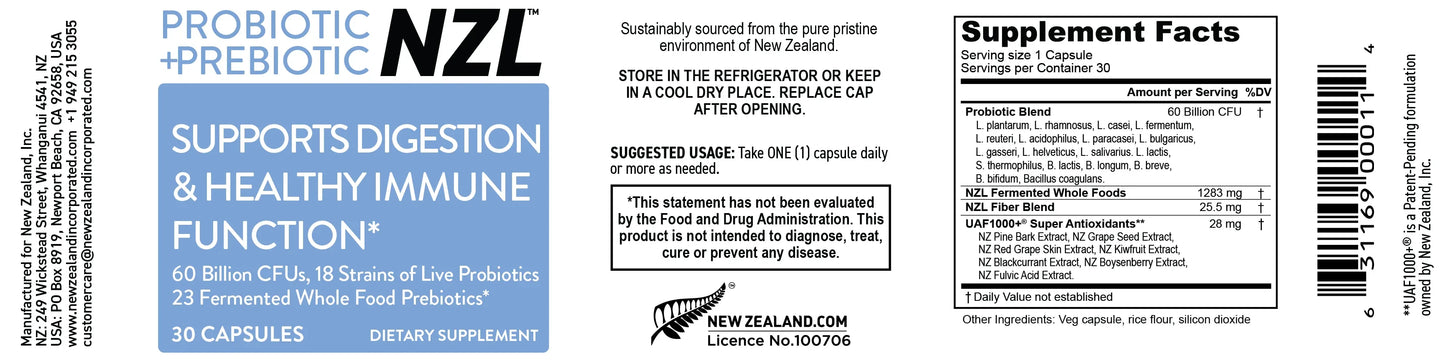
Probiotic + Prebiotic NZL Capsules, Once Daily 60 Billion CFUs, Digestive Health for Men and Women, 18 Strains, Shelf Stable, With Fermented Wholefoods, Prebiotic & Fibre, 30 Capsules
Estimated processing time: Orders before noon Pacific Time process same day, later orders process next business day.
Estimated shipping time: Average shipping transit time is 3–5 business days.
Couldn't load pickup availability
- THIS UNIQUE PROBIOTIC PREBIOTIC COMBINATION offers several advantages over standard probiotics, which include: the pre-digestion of complex foods that dramatically improves the absorption of many vitamins. enhanced mineral bio-accessibility and increased bioavailability of key antioxidants. restore and balance alkalizing effect on the body's pH.
- A SUPERIOR FORMULATION: When you combine the 23 fermented whole foods with our unique blend of 18 strains of probiotic bacteria, you get these Key Health Benefits; Superior gut health with improved digestion & IBS support and Immune support.
- PROBIOTIC+PREBIOTIC NZL supports you and your gut with an optimal combination of fermented raw whole foods, 18 strains of best-in-class probiotic bacteria, and prebiotic fibre, combined to improve your health and well-being. Our product is designed for both Men and Women.
- Dairy & gluten-free, no refrigeration required & made to strict GMP standards. Every batch is third-party tested to ensure the ingredients are safe, pure, and effective. Made with no artificial preservatives. Our probiotics are made for women and men. They contain 60 Billion.
Share

Superior Gut Health, Naturally
A unique multi-strain probiotic + prebiotic blend with 60+ billion CFUs and fermented superfoods — for optimal digestion, immunity, and wellness.
We developed a Superior Probiotic Blend containing more than 60 Billion live organisms, including
Lactobacillus plantarum, Lactobacillus rhamnosus, Lactobacillus casei, Lactobacillus fermentum, Lactobacillus reuteri, Lactobacillus acidophilus, Lactobacillus paracasei, Lactobacillus delbrueckii subsp. bulgaricus, Lactobacillus gasseri, Lactobacillus helveticus, Lactobacillus salivarius, Lactococcus lactis subsp. lactis, Streptococcus thermophilus., Bifidobacterium animalis subsp. lactis, Bifidobacterium longum, Bifidobacterium breve, Bifidobacterium bifidum, Bacillus coagulans strains—proven to support digestion, immunity, and metabolic health.
Improves Digestive Health
The probiotics produced during fermentation will restore and rebalance the friendly bacteria throughout your digestive system and can often reduce the systems of some common digestive ailments
M L Ritchie, 2012 [https://pubmed.ncbi.nlm.nih.gov/22529959/]
Including the troublesome and difficult to alleviate symptoms of irritable bowel syndrome (IBS), a common digestive disorder
N Hoveyda, 2009 [https://pubmed.ncbi.nlm.nih.gov/19220890/]
Fermented foods have also been shown to reduce the severity of diarrhoea, bloating, gas, and constipation
E Dimidi 2014 [https://pubmed.ncbi.nlm.nih.gov/25099542/]
So, getting more fermented whole foods into your diet is an excellent idea if you regularly experience these types of gut issues.
We have added a Specialized Antioxidant and Fiber Blend to support our Probiotics.
Sunfiber Guar Gum Seed
Kiwifruit Enzyme
Broccoli Sprout
UAF1000+® Superfood Antioxidant
Our Fermented Wholefood Prebiotic Powder Is Made From 23 Superfoods
Mung Beans, Chick Peas, Brown Rice, Red Lentils, Linseed, Spirulina, Barley Grass, Alfalfa Grass, Quinoa, Chia Seed, Amaranth Grain, Asparagus, Beetroot, Broccoli, Chicory Root, Onion, Sweet Potato, Dunaliella Salina, Fresh Ginger, Shitake Mushroom, Cordyceps, Reishi Mushroom, Molasses
Our Probiotics are a Unique Blend that Provide the Following Benefits
• Excellent colonization, which means the probiotics remain effective, longer.
• Production of beneficial fermentation compounds which modulates immunity and stimulates cellular repair.
• Supports overall gastrointestinal health and wellness.
• Improves digestion and nutrient absorption from food which is better for your health and you generally eat less.
Makes Food Easier to Digest
The fermentation process is able to break down carbohydrates and other nutrients from plants, making these nutrient-rich whole foods much easier to absorb and digest than similar non-fermented foods.
One of the best-known examples is the fermentation of the milk sugar called lactose, which is found in most dairy products. Lactose which is a complex sugar is broken down by lactic acid-producing during the fermentation process into simple sugars for easy absorption.
This means that people who suffer from lactose intolerance (the inability to digest lactose) should have few problems consuming fermented dairy products like yoghurt and kefir.
Another way that fermentation makes food easier to digest, is by helping to break down and destroy compounds that are called "anti-nutrients" that can block the absorption of many essential nutrients from the diet (eg "anti-nutrients" like phytates from grains and lectins from legumes).
Anti-nutrients are naturally occurring plant compounds, which have evolved to discourage grazing animals from consuming them. They are found in types of foods such as legumes, nuts, grains and seeds where they interfere with the nutrient absorption from within other foods. Fermentation is a great strategy to minimize the impact that these anti-nutrients have on the body.
The Human Microbiome
The 'Human Microbiome' is the term used to describe the collection of all microorganisms, including bacteria and yeasts that live in and on the human body. The gastrointestinal tract has the densest and most diverse microbial community of the human body. In 2003, the Human Genome Project was completed. It revealed that our inherited genes explain only about 10% of human disease. The remaining 90% are driven by environmental factors — including our gut microbiome. Our microbiome acts like a genetic switchboard: the types of bacteria present can turn genes on or off. It’s as unique as a fingerprint — and changes rapidly with diet, lifestyle, toxins, and antibiotics. Probiotics, when taken regularly and in sufficient amounts, help strengthen this ecosystem and deliver real health benefits.
Frequently Asked Questions
What are probiotics and prebiotics, and why are both essential for our gut?
Probiotics are microorganisms, the smallest living things or "good" or beneficial bacteria that reside on or in our intestines. Prebiotics are fiber and, at the same time, the proper and vital food for probiotics. Without prebiotics, beneficial bacteria, or probiotics, cannot survive.
What foods count as Fermented Foods?
Fermented foods include anything fermented, such as plain yogurt, kefir, buttermilk, sauerkraut, kombucha, miso, kimchi, apple cider vinegar, pickles, and yeast; in other words, anything that is fermented.
Did you know this about your intestines?
The intestine is the largest and the longest internal human organ, measuring up to 7½ meters. Even though the diameter of the intestine is only a few centimeters, your gut contains folds, millions of villi, and billions of microvilli whose total surface area is estimated to be between 250 and 500 square meters. Quite large, considering that a tennis court measures about 260 square meters. The fact that your intestine is so large has a sensible reason because during an entire lifetime, about 30 tons of food, toxins, microbes, pathogens, and indigestible substances and 50,000 liters of liquid pass through the intestine. To digest these quantities of food, a large contact area of the intestine with the food is therefore beneficial.
What are the tasks of the intestine?
The tasks of the intestine are many. It ensures the breakdown of food and the optimal absorption of essential substances into the body. In doing so, it must distinguish which food components enter the body and which food residues must be excreted again to relieve the body of harmful pollutants.
In addition, the intestine produces hormones and plays a significant role in regulating the water balance, which requires reabsorbing and excreting large amounts of fluid. One of the most important roles of the intestine is that it serves as a protective barrier for pathogens, which is why it's so important that you take care to keep your intestinal wall healthy, as well as your little beneficial billions of roommates, meaning your bacteria.
So the gut has several quite demanding tasks vital to your health. With NZL Probiotic+Prebiotic, we want to help you maintain and promote your gut health.
What is the microbiome?
The microbiome is the sum of all microorganisms, tiny living things such as bacteria, and other single-celled organisms located on or in our human body. Humans have more living bacteria in their bodies than cells, about 390 trillion, the equivalent of about 2 kg of our body weight. 99% of the bacteria are found in our intestines, where there are about 1000 different species of bacteria. Bacteria have some essential tasks for the human body. They play an important role in digestion, production of vitamins, and defense against pathogens, and contain harmful germs. They also have a significant impact on our immune system.
Why is it so important to keep our gut flora healthy?
Intestinal health is of utmost importance to everyone. The intestines can be massively affected by years of consuming nutrient-less, industrially processed foods and medications such as antibiotics. Because once the intestinal health is out of balance, unpleasant symptoms can develop due to "bad" harmful intestinal bacteria and secondary diseases such as "leaky gut." Once the balance of the intestinal flora is disturbed, a so-called dysbiosis can quickly develop, in which undesirable microorganisms spread and take control. As a result, inflammatory processes of the intestinal mucosa occur. So it is crucial to have a healthy intestinal flora and intestinal mucosa, as well as a functioning intestinal-associated immune system and also an optimal interaction of all these components.